
6 Signs Your Child Might Need a Mental Health Evaluation
Updated: Aug 18

Quick Summary
Nearly 1 in 5 U.S. children (ages 3–17) has a diagnosed mental, emotional, developmental, or behavioral disorder, according to the CDC struggling kids are far more common than most parents realize.
Every child has hard days; the real signal is when changes in mood, behavior, or personality continue for several weeks rather than passing on their own.
A sudden drop in school performance or motivation is often one of the earliest and clearest signs something deeper may be going on.
Big emotional outbursts that feel disproportionate to the situation can be a child's way of expressing something they don't yet have words for.
Social withdrawal pulling away from friends, family, or activities they used to love deserves attention when it continues alongside other changes.
Physical complaints like stomach aches or trouble sleeping can sometimes be a child's anxiety showing up in their body instead of their words.
A mental health evaluation isn't about labeling your child it's a conversation designed to understand their experience and identify the right support, whether that's child therapy and psychiatry or continued observation.
You don't need to wait for a crisis trusting your instincts as a parent is often the first and most important step toward getting your child support.
Every child has difficult days. They may come home from school feeling upset, become quieter than usual, or have moments when their emotions seem bigger than the situation. In many cases, these changes are simply part of growing up.
But sometimes, parents notice something that feels different. A child who once loved spending time with friends starts pulling away. School suddenly becomes a struggle. Worry seems to follow them everywhere. When changes continue for weeks or begin affecting everyday life, it may be time to look a little closer.
A mental health evaluation is not about putting a label on your child. It is about understanding what they are experiencing and finding the right support if they need it. In this guide, we will look at six signs that may suggest your child could benefit from a mental health evaluation, along with practical advice on what parents can do next.
Is It Just a Phase or Is It Time to Look a Little Closer?
Most children experience emotional ups and downs as they grow. A mental health evaluation may be helpful when changes in mood, behavior, sleep, or school performance continue for several weeks or begin affecting daily life. Early support is not about expecting the worst. It is about giving your child the opportunity to receive the care they may need before small challenges become bigger ones. Did You Know? According to the CDC, nearly 1 in 5 children in the U.S. (ages 3–17) has been diagnosed with a mental, emotional, developmental, or behavioral disorder — and early recognition can make a meaningful difference in how well a child responds to support.
Source (verified): CDC – Data and Statistics on Children's Mental Health
Key Takeaways
Every child has emotional ups and downs.
Lasting changes deserve attention.
Parents often notice changes before anyone else.
Early support can make a meaningful difference.
A mental health evaluation helps understand your child's needs, not define who they are.
Table of Contents
When should parents become concerned?
Six signs your child may benefit from a mental health evaluation
Questions to ask before assuming the worst
What happens during a mental health evaluation?
When is the right time to seek support?
Conclusion
Every Child Has Hard Days and That Is Completely Normal
Children are still learning how to understand and express their emotions.
One week they may seem frustrated because of school. Another week they may be upset after an argument with a friend. These experiences are a normal part of growing up.
What matters is not one difficult day.
What matters is whether those changes continue, become more intense, or begin affecting your child's everyday life.
As a parent, you know your child better than anyone else. If something feels different for a long period of time, it is okay to trust your instincts and ask questions.
1. Your Child Just Does Not Seem Like Themselves Anymore

Sometimes the first sign is difficult to explain.
You may simply feel that your child's personality has changed.
Perhaps they used to laugh more, enjoy family activities, or look forward to spending time with friends. Now they seem distant, unusually quiet, or no longer interested in things they once loved.
Every child changes as they grow.
The difference is when these changes continue for weeks and become part of their everyday life rather than a temporary reaction to a stressful event.
2. School Suddenly Feels Much Harder

School often gives parents important clues about how a child is feeling emotionally.
A child who is struggling with their mental health may find it harder to focus, complete homework, or stay motivated in class.
Teachers may also notice changes before parents do.
That does not automatically mean there is a mental health condition.
However, when emotional struggles begin affecting learning, it may be worth exploring what is happening beneath the surface.
What Parents Might Notice
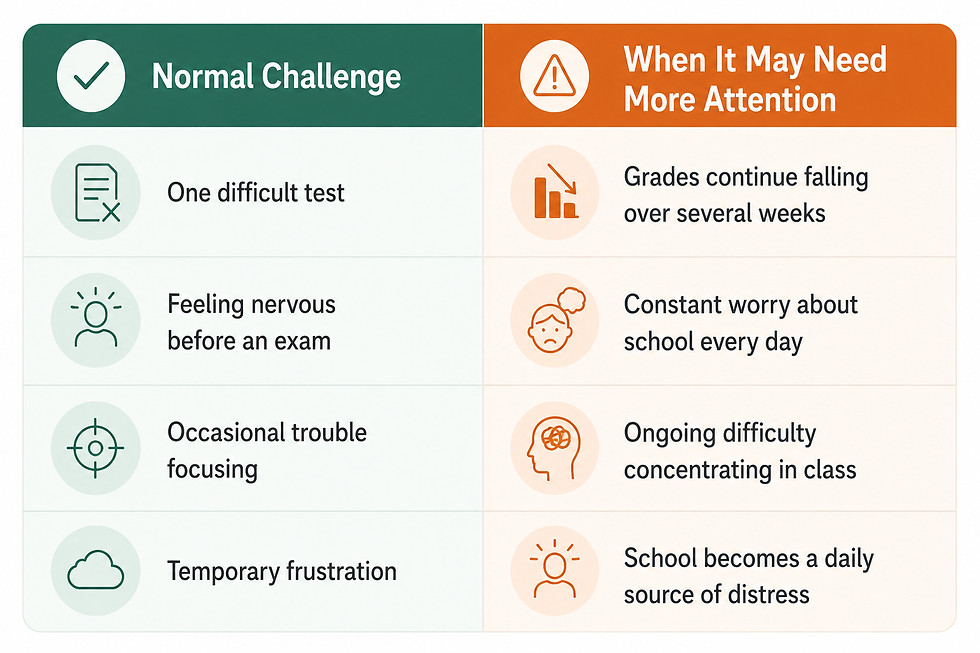
Looking at the bigger picture often gives a clearer understanding than focusing on one difficult day.
3. Big Emotions Are Becoming Everyday Emotions

Children naturally experience strong emotions.
They may cry when they are disappointed or become frustrated when things do not go their way.
The concern is not that children have emotions.
The concern is when those emotions become much harder to manage than before.
You might notice:
Frequent emotional outbursts.
Anger that seems much bigger than the situation.
Crying more often than usual.
Difficulty calming down after becoming upset.
These changes can sometimes be a sign that your child is struggling with something they do not yet know how to express.
Rather than asking, "Why are they behaving this way?"
It can be more helpful to ask,
"What might they be trying to tell me?"
That simple shift in perspective often opens the door to more understanding.
4. They Are Pulling Away From the People They Care About

Children and teenagers sometimes want more independence.
That is a normal part of growing up.
However, there is a difference between wanting some quiet time and withdrawing from everyone around them.
Your child may begin:
Avoiding friends.
Spending most of their time alone.
Losing interest in hobbies.
Turning down activities they once enjoyed.
Avoiding family conversations.
These changes do not always point to a mental health concern.
But if social withdrawal continues alongside other emotional or behavioral changes, it deserves attention.
Many children find it difficult to explain how they feel.
Sometimes their behavior speaks before their words do.
5. Worry Seems to Be Following Them Everywhere
It is normal for children to worry from time to time.
They may feel nervous before a test, a sports event, or their first day at a new school.
Usually, those worries come and go.
But when worry becomes part of everyday life, it can start affecting how a child thinks, feels, and behaves.
You may notice that your child:
Frequently asks for reassurance.
Worries about things that seem unlikely to happen.
Complains of stomach aches or headaches before school.
Has trouble relaxing, even during fun activities.
Seems constantly on edge.
Sometimes children cannot explain their anxiety with words. Instead, it shows up through physical symptoms or changes in behavior.
If worry seems to follow your child wherever they go, it may be helpful to talk with a mental health professional who can better understand what they are experiencing.
6. Small Changes in Daily Habits Can Tell a Bigger Story
Parents often notice changes in routines before they notice changes in emotions.
A child who usually sleeps well may suddenly struggle to fall asleep. Someone with a healthy appetite may begin eating much more or much less than usual.
These changes do not always mean there is a mental health concern.
However, when they happen alongside other emotional or behavioral changes, they can provide important clues.
Some changes to watch for include:
Sleeping much more or much less than usual.
Changes in appetite.
Low energy most days.
Difficulty following normal daily routines.
Less interest in activities they once enjoyed.
Children communicate in many different ways.
Sometimes those messages come through changes in their daily habits rather than through words.
Before You Assume the Worst, Start With a Conversation
If you have noticed some of these signs, it is natural to feel concerned.
Before jumping to conclusions, try creating a calm space where your child feels safe to talk.
You do not need to have all the answers.
Sometimes simply listening is the most important first step.
Instead of asking questions that feel overwhelming, try gentle conversation starters like these:
"I've noticed you haven't seemed like yourself lately. How have you been feeling?"
"Has anything been making school harder recently?"
"What has been the hardest part of your week?"
"Is there anything you've been worried about that you haven't told me yet?"
Your child may not open up right away.
That is okay.
The goal is to let them know you are there to listen without judgment whenever they are ready.
What Happens During a Mental Health Evaluation?
Many parents hear the words "mental health evaluation" and immediately feel nervous.
In reality, it is simply a way to better understand what your child is experiencing.
The process is not about judging your child or giving them a label.
It is about listening, asking questions, and building a clearer picture of their emotional wellbeing.
What You Can Expect
During the Evaluation | Why It Matters |
A conversation with you and your child | Helps understand current concerns and family observations |
Questions about emotions, behavior, school, and home life | Builds a complete picture of your child's experiences |
Discussion of strengths as well as challenges | Looks at the whole child, not just the difficulties |
Personalized recommendations | Helps identify the support that may be most helpful |
Every child is different.
That is why evaluations focus on understanding each child's unique needs rather than following the same approach for everyone.
When Is It Time to Seek Professional Support?
There is no perfect moment to ask for help.
You do not have to wait until your child is in crisis.
Consider reaching out if:
Changes have lasted several weeks.
School performance has noticeably changed.
Your child has stopped enjoying activities they once loved.
Anxiety, sadness, or emotional outbursts are becoming more frequent.
Sleep or eating habits continue changing.
Your instincts tell you something is not quite right.
Parents often know when something feels different.
Trusting those instincts can be an important first step toward getting answers and support.
Conclusion
Watching your child struggle can be one of the hardest experiences for any parent.
While every child has emotional ups and downs, lasting changes in mood, behavior, or daily routines deserve attention. Recognizing these signs does not mean expecting the worst. It means being willing to understand what your child may need.
Remember that asking for help is not a sign that you have failed as a parent. It is a way of making sure your child has the opportunity to grow, heal, and thrive with the right support.
Frequently Asked Questions
1. What are the signs that a child may need a mental health evaluation?
A child may benefit from a mental health evaluation if they show lasting changes in mood, behavior, sleep, eating habits, school performance, or relationships. If these changes continue for several weeks or begin affecting everyday life, it may be time to seek professional guidance.
2. Is it normal for children to have emotional ups and downs?
Yes. Children naturally experience a wide range of emotions as they grow. Feeling sad, frustrated, or worried from time to time is a normal part of development. The concern is when these changes become more intense, last for several weeks, or begin interfering with daily activities.
3. When should I worry about my child's behavior?
You may want to pay closer attention if your child no longer seems like themselves, avoids activities they once enjoyed, struggles at school, has frequent emotional outbursts, or experiences ongoing anxiety or sadness. These changes may suggest they could benefit from professional support.
4. Does my child need therapy or just more time?
Not every child who is struggling needs therapy right away. However, if emotional or behavioral changes continue despite your support at home or begin affecting school, friendships, or family life, speaking with a mental health professional can help you better understand what your child needs.
5. What happens during a child mental health evaluation?
A child mental health evaluation usually includes conversations with both the child and their parent or caregiver, questions about emotions, behavior, school, and family life, and recommendations based on the child's individual needs. The goal is to understand what your child is experiencing, not to judge or label them.
6. Will my child automatically receive a diagnosis after an evaluation?
Not necessarily. An evaluation is designed to gather information and better understand your child's emotional and behavioral wellbeing. In some cases, no diagnosis is made, and the recommendation may simply be additional support, therapy, or continued observation.
7. Can anxiety or stress affect a child's behavior?
Yes. Children often express stress and anxiety differently than adults. Instead of talking about their feelings, they may become irritable, withdrawn, worried, or have changes in sleep, appetite, or school performance.
8. How can I talk to my child if I think something is wrong?
Start with a calm and supportive conversation. Ask open ended questions, listen without interrupting, and avoid rushing to solve the problem immediately. Let your child know they are safe to share how they are feeling and that you are there to help.
9. How do I know if my child needs a mental health evaluation or is just going through a phase?
Most children go through temporary emotional changes as they grow. A mental health evaluation may be helpful if those changes last for several weeks, become more severe, or begin affecting your child's daily life, relationships, or school performance.
10. How does MorMindful support children and teens?
MorMindful provides personalized mental health care for children and teenagers through therapy, family therapy, Play Therapy, Cognitive Behavioral Therapy, EMDR, Dialectical Behavior Therapy, and psychiatry services when appropriate. The focus is on understanding each child's unique needs and helping families build healthy coping skills together.


